Essays and Conversations on Community & Belonging

The Sovereign Sanctuary
Reclaiming the Libertarian History of the Leather Subculture from the Shadow of Randy Shilts
SYSTEMS & INCENTIVESSUBCULTURE & COMMUNITYCULTURAL & ARTISTIC ANALYSISSOCIAL & POLITICAL COMMENTARY
Alex Pilkington
2/18/20266 min read
The Convenient Villain
In October 1984, as San Francisco's Board of Supervisors debated the forced closure of its bathhouses, a 35-year-old gay Republican lawyer named Duke Armstrong walked into the fight that would define his legacy — and, he understood, his community's survival. Armstrong was president of the Concerned Republicans for Individual Rights, a veteran of the Briggs Initiative battle, a leatherman, and a member of the bar. He had spent years building bridges between San Francisco's gay community and a Republican Party that regarded it with suspicion, and now he was about to make the argument that the Democratic establishment on both ends of the political spectrum could not, or would not, hear: that the bathhouses were not the enemy. The state was.
Randy Shilts's And the Band Played On, published three years later as Shilts faced his own terminal diagnosis, would write men like Armstrong out of the history of the AIDS crisis — or rather, write them in as villains. In Shilts's telling, those who lobbied against closure were merchants of death, blinded by profit and libertinism. But Shilts's narrative force, considerable as it is, rests on a flawed premise. A closer examination of the debates in San Francisco, Washington D.C., and Miami reveals that what he dismissed as deadly lobbying was, in fact, a principled legal and philosophical defense of communal sovereignty — one with consequences that reached far beyond the bathhouses themselves.
The Vanguard of the Visible: Leather as Infrastructure
To understand what was actually at stake in 1984, we must first understand what the leather community had built, and how.
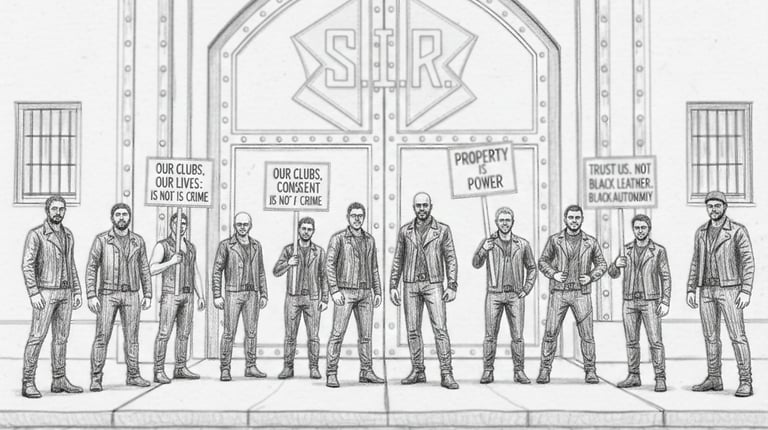
We must distinguish between "gay" as a demographic and "leather" as a disciplined society of owners. While the broader movement after Stonewall sought social acceptance from the existing power structure, the leather community built the material infrastructure of its own survival. From Chicago to Miami, men like Chuck Renslow and Jack Campbell did not merely open bars; they bought the real estate, signed the leases, and created the first concentrated centers of economic power the community ever owned. Their spaces were not just venues for sex — they were gyms, community centers, networking hubs, and as activist Harry Breaux later recalled, "the golf games of the community," where deals were made and careers were built in an environment of towel-clad equality that flattened the social hierarchies of the outside world.
This was what I'd call Leather and Lavender in action: the hard-won understanding that if you do not own the land, you do not own your liberation. The leather community's willingness to occupy abandoned industrial zones — San Francisco's SoMa district, the warehouse corridors of D.C. — was a classic act of libertarian homesteading. They had built a state within a state that functioned precisely when the actual state failed them. That state was now threatening to take it.
The Architecture of Resistance
Duke Armstrong grasped what many in the public health establishment could not: that the bathhouses were not a liability to be quarantined, but an asset to be deployed.
The leather community had pioneered a specific architecture of resistance. By adopting a private membership model, it had transformed what would otherwise be regulated public accommodations into voluntary private associations. This was not a loophole; it was a deliberate legal and philosophical strategy, one that Armstrong — a practicing attorney who had used the same logic to fight the Briggs Initiative and proposed marshaling the IRS against the Moral Majority's tax-exempt status — understood with precision. A membership card was a juridical deadbolt. It established a private jurisdiction governed by the contractual ethics of consent and self-ownership rather than by municipal code.
When Mayor Dianne Feinstein authorized SFPD officers to enter the bathhouses as undercover surveillance agents — a fact documented in the Coming Up! independent review and condemned by the San Francisco Human Rights Commission — she was not conducting a health inspection. She was violating the sanctity of the voluntary society. Armstrong's response, in partnership with prominent civil rights attorney Thomas H. Steel, was to represent the bathhouse owners in court, seeking to hold that line against what he recognized as a jurisdictional seizure that would outlast the emergency used to justify it.
He was right. The injunction that resulted from the November 1984 ruling — which prohibited private rooms and required monitoring — remained in effect throughout the 1980s and '90s, long after the specific conditions that had prompted it had changed beyond recognition. As the LGBTQ Policy Journal later observed: "A heterosexual judge with no gay advisory committee determined what was an acceptable venue for men who have sex with men." This is what state coercion dressed as public health actually looks like.
The D.C. and Miami Cases
Shilts focused his narrative on San Francisco, but the argument for community sovereignty was being made simultaneously — and for even more urgent reasons — in Washington D.C. and Miami.
In D.C., for many Black gay men, the barrier to healthcare was not denial of the crisis but a rational, historically grounded distrust of the medical establishment itself. The ClubHouse on Upshur Street demonstrated what Armstrong had argued in San Francisco: that a private, community-owned institution could accomplish what no public agency could. As a trusted space, it served as a site of what organizers called stealth health — outreach that reached men who would never have walked into a government clinic, precisely because it existed outside the surveillance of a government that had given them no reason for trust.
In Miami, the calculation was equally clear-eyed. The city's gay community lived in the long shadow of Anita Bryant's Save Our Children campaign. Any representative of the state arriving under the banner of public welfare was rightly regarded as an agent of the same machinery that had targeted them for years. For these men, the fight to maintain their spaces was not a fight for the right to be reckless. It was a fight to preserve the only communication networks they actually trusted — the networks through which information about the epidemic could flow to men who would receive it from no other source.
Shilts never fully grappled with this. His framework required a villain, and the bathhouse owners were convenient. He could not accommodate the more difficult truth: that in many communities, the state was not the solution. It was the problem the bathhouses had been built to solve.
The Legacy of Duke Armstrong
Duke Armstrong died on a Monday evening at Davies Medical Center in San Francisco. He was 39 years old. His partner, Jerry Roberts, was with him. He had requested that there be no memorial service.
The obituary published in the Bay Area Reporter was spare by necessity — Armstrong was, in many ways, a private man who had chosen public battles. But the measure of what he left behind is not difficult to take. He had served as president of the Concerned Republicans for Individual Rights for two years, building a bridge between the GOP and San Francisco's gay community in a city where Republicans began the decade severely outnumbered. He had fought the Briggs Initiative, recruited men from the leather community into political organizing, and used his law license as a weapon against every institution — municipal, federal, and ecclesiastical — that sought to govern what consenting adults did in private. In 1986, his peers voted him Mr. CMC Carnaval. The San Francisco Board of Supervisors awarded him a Certificate of Honor.
He received none of this recognition from Randy Shilts.
Armstrong did not fight for the right to be reckless. He fought for the right of adults to make their own risk assessments within the bounds of private property — and for the right of a community to govern itself by its own considered ethics. He recognized, with the clarity that comes from practicing law in a system designed for people unlike him, that when a community invites the state to regulate its private life under the guise of public health, it grants that state a jurisdiction it will never voluntarily relinquish. The injunction that outlasted the epidemic proved him correct.
Shilts's tragedy was not malice. It was the conviction that the only available choice lay between communal neglect and state coercion. He chose the state. In doing so, he could not see that men like Armstrong had already found the third way — and had been building it, brick by brick, lease by lease, membership card by membership card, for a decade before the crisis arrived.
The Closing Word
The leather subculture has never been a flight from responsibility. It has always been an embrace of it. By centering consent, contract, and property, this community built the fortress that allowed a movement to survive a plague. In San Francisco, in D.C., in Miami, the men who fought to keep their spaces open were not gambling with other people's lives. They were making a sophisticated, legally grounded, morally serious argument about who has the right to govern a community in crisis — and the answer they gave was: the community itself.
Duke Armstrong did not live to see the injunction lifted. He did not live to see sex clubs reopen in the 1990s on precisely the terms the community had proposed in 1984, or to see San Francisco's Health Department finally rescind the bathhouse restrictions in January 2022. But the architecture of resistance he helped design held.
We can honor the dead without surrendering the right of the living to be free. The lobbying was the sound of a community refusing to be erased. It is past time we recognize the leathermen of 1984 — and the lawyer who stood up in court to defend them — not as the antagonists of a crisis, but as the guardians of the sovereign sanctuary.