Essays and Conversations on Community & Belonging

The Paradox of the "Anti-Traditionalist"
Why Subcultures Need Norms to Survive
SUBCULTURE & COMMUNITYCULTURAL & ARTISTIC ANALYSISTHE ARCHITECTURE OF FRAGMENTATIONSOCIAL & POLITICAL COMMENTARY
Alex Pilkington
1/20/20262 min read
I was at the Mid-Atlantic Leather (MAL) contest this past weekend, surrounded by the energy and history of that event. Amidst the celebration, the person sitting next to me introduced himself with a peculiar label: an "anti-traditionalist."
When I inquired about the reasoning behind this stance, his answer was swift and seemingly virtuous. He explained that tearing down traditions was the "most inclusive approach." By removing the old guardrails, the logic goes, you make room for everyone.
It sounds nice on the surface. Who doesn't want inclusivity?
But when I pushed back, the atmosphere grew instantly cold. I pointed out a glaring paradox in his philosophy: If your version of inclusivity requires an aggressive dismantling of the past, you aren't including the very individuals who built the community we were currently enjoying. You cannot claim to be inclusive while treating the architects of your space with disdain.
This encounter highlighted a growing rift, not just in the leather world, but in many subcultures. There is a fundamental misunderstanding of what tradition actually does.
Tradition is Infrastructure, Not Oppression
In subcultures—especially subversive ones like the leather community—traditions aren't just arbitrary rules meant to gatekeep. They are the transmission mechanism of culture. They are survival codes, rituals of recognition, and shared languages passed down by those who navigated tougher times.
The real issue with the current wave of postmodern ideology embracing many communities is an eagerness to negate norms simply because they are norms. There is a reflex to view any structure as inherently oppressive.
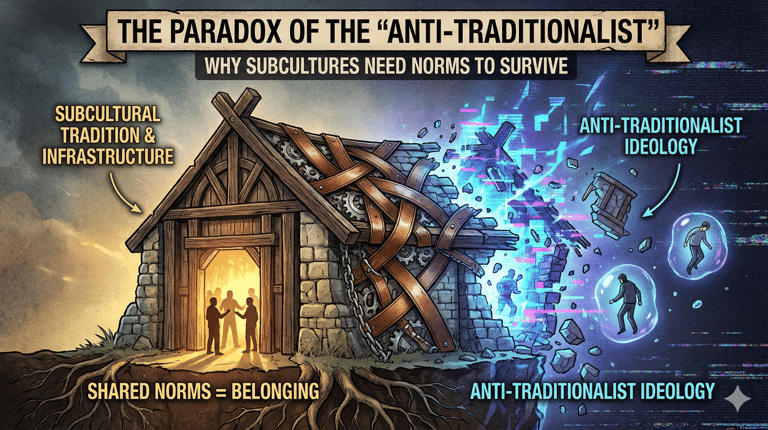
But this approach is slowly eroding the infrastructure that enables communities to become places of belonging in the first place.
Think of a community like a house. Traditions and norms are the framing, the foundation, and the floorboards. You can renovate the house; you can paint the walls different colors and rearrange the furniture to accommodate new guests. But if you decide that the very idea of "walls" or "foundations" is oppressive and tear them out in the name of freedom, you don't end up with a more inclusive house. You end up with rubble.
The Path to Isolation
By viewing the traditions that built our institutions with utter disdain, we destroy the possibility of converging on shared values.
A community isn’t just a random assortment of bodies in a room. It is defined by a shared "we." If every norm is dismantled, if every shared ritual is viewed as suspect, we are left with nothing but isolated individuals occupying the same space.
Without the ability to converge on shared values, we lose the very thing that staves off modern isolation. We need to stop confusing structure with exclusion. To sustain a culture, we need a foundation. You cannot build a lasting home for belonging if you are constantly tearing up the floorboards.