Essays and Conversations on Community & Belonging

The Hand That Can’t Be Held: Why We Streamed a Tragedy
Listening to Juice WRLD’s "Feel Alone" posthumously feels like reading a suicide note published as poetry. It is a real-time documentary of psychological disintegration that transcends the "emo-rap" label. In this essay, I perform a psychological autopsy of the track using the lenses of Carl Jung and Jean-Paul Sartre. By mapping the lyrics against the concepts of the Shadow, the Persona, and the Existential Void, we can uncover the precise mechanism of why, even when help is right in front of us, we sometimes lose the capacity to comprehend it. This is an exploration of the demons we try to drug into submission and the tragedy of being seen but not noticed.
CULTURAL & ARTISTIC ANALYSISLYRICAL EXEGESISSHADOW AND PERSONAADDICTION & DOPAMINE"SOUNDCLOUD SORROW"
Alex Pilkington
12/4/202512 min read
There's something uniquely unsettling about listening to Juice WRLD's "Feel Alone" now, after his death. This isn't just another track about depression or drug use, it's a real-time documentary of psychological disintigration, captured in four minutes of stream-of-consciousness rap. It's like reading a suicide note hidden in poetry - raw, unfiltered, and prophetic in ways the artist himself might not have fully grasped.
The song is an authentic testimony and reflects a raw articulation of a consciousness at war with itself, caught between the mask it shows the world and the void it feels within.
I want to examine this song through two philosophical lenses that, taken together, offer a kind of psychological autopsy: Carl Jung's depth psychology and Jean-Paul Sartre's existentialism. Jung gives us the map of the internal terrain (the Shadow, the Persona, the collective unconscious). Sartre gives us the existential stakes (the anguish of freedom, bad faith, the necessity of the Other's gaze). Between them, we can understand not just what Juice WRLD was feeling, but the precise mechanisms of his suffering and why the help he occasionally received couldn't penetrate the fortress of his pain.
This isn't an academic exercise. Understanding this dynamic matters because what Juice WRLD describes isn't unique to him. It's a pattern that repeats across celebrity/influencer culture, across addiction, across the modern condition of mediated existence where we perform versions of ourselves while our actual selves slowly suffocate.
The song opens with a deceptively simple line: "I pray this reefer help me get rid of my demons." There's a boxer's rhythm to the delivery. The beat stepping back and forth, preparing for confrontation. But the opponent isn't external. The fight is internal, and the strategy is fundamentally flawed.
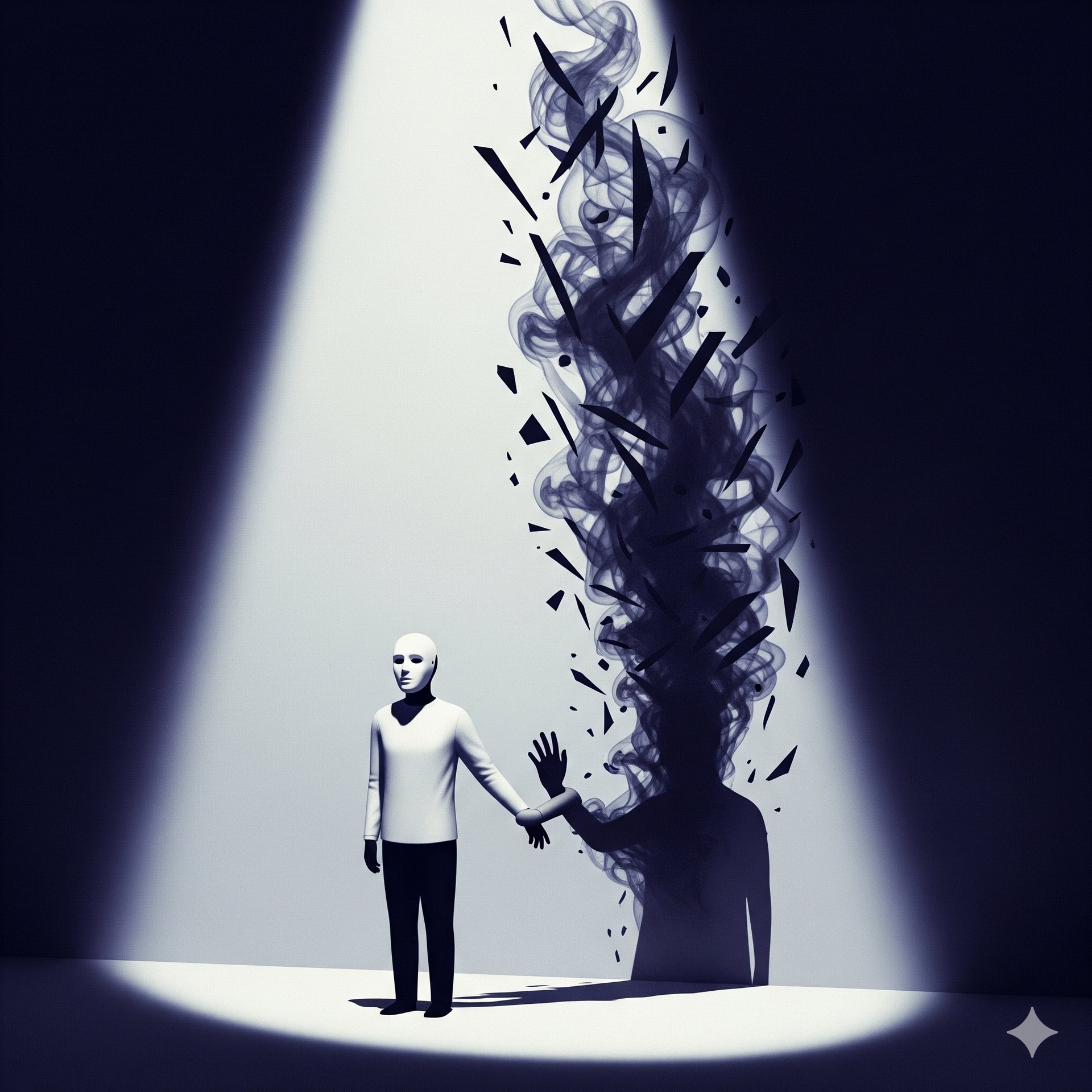
This is what Jung called the Shadow: the repository of everything we reject, repress, or deny about ourselves. It contains our insecurities, our shame, our darkest impulses, our unacceptable desires. The Shadow isn't some external demon that invaded you; it's made of you, constructed from all the parts of yourself you've tried to excise.
Here's the crucial Jungian insight that Juice WRLD didn't know: You cannot "get rid of" the Shadow. That's not how the psyche works. The Shadow doesn't respond to exile or elimination. It responds to integration. The more you try to destroy it, repress it, drug it into submission, the denser and more hostile it becomes. It's like trying to defeat your own shadow by turning off the lights - you haven't eliminated it; you've just made everything darker.
By using substances to "get rid of" his demons, Juice WRLD was engaged in what Jung would recognize as the most dangerous form of Shadow work: violent repression. And here's the trap: The drugs might temporarily numb the pain, might create the illusion that the Shadow has receded, but they also prevent the conscious Ego from developing the strength necessary to actually integrate the Shadow. You're not fighting your demons; you're just sedating yourself while they grow stronger in the dark.
From a Sartrean perspective, this connects to what he called the "Anguish of Freedom." We are, in Sartre's famous formulation, "condemned to be free." We cannot escape responsibility for our existence. Every moment requires us to choose who we will be, and that responsibility is terrifying. The substance use represents an attempt to dissolve the self temporarily, to create a vacation from the exhausting work of being a conscious, choosing agent. If you're high enough, you don't have to face the Shadow. You don't have to make choices. The war stops, or at least it seems to.
But this is, of course, an illusion. The Shadow doesn't disappear when you're unconscious. It just operates without supervision.
The hook of "Feel Alone" articulates something that anyone who's experienced depression will recognize: the peculiar isolation of being surrounded by people while feeling fundamentally unseen. "There's times when I feel alone / I wonder if anybody notices."
This gets at something Jung understood better than almost anyone: the suffocating quality of the Persona. The Persona is the mask we wear for society; it's the carefully constructed public face we present to navigate the social world. For Juice WRLD, the Persona was the successful rapper, the charming artist, the guy who seemed to be "in his prime." He admits this explicitly in the song: externally thriving, internally rotting.
Here's the Jungian tragedy: When the Persona becomes too thick, too convincing, too successful at its job, it begins to cut off oxygen to the True Self. The mask becomes a prison. People respond to the mask with admiration, with attention, with love, but none of it reaches you because none of it is directed at you. It's all bouncing off the Persona.
Juice WRLD wonders if anybody notices him beneath the mask. The terrible answer, the one he seems to already know, is: probably not. The Persona is too good at its job. He has successfully hidden himself so completely that even when he tries to signal distress, people mistake it for artistic expression, for authenticity performed, for the expected behavior of an "emo-rapper."
From Sartre's perspective, this connects to his concept of "The Look" (Le Regard). We are, Sartre argued, fundamentally dependent on the Other to confirm our existence. We need to be seen to be real. But if the Other only sees our Persona, only sees the mask,then our actual Self ceases to exist in the social world. We become, in a very real sense, ghosts in our own lives.
This is the peculiar hell of the celebrity: maximum visibility, minimum recognition. Millions of people look at you. None of them see you. The real Juice WRLD (the frightened, suffering person beneath the artist persona) is invisible precisely because everyone is watching him.
One thing that strikes me about "Feel Alone," and much of Juice WRLD's work, is how stream-of-consciousness it feels. He was famous for freestyling entire songs and entire albums, letting words pour out without preparation, without heavy editing. From a technical perspective, it's impressive. From a psychological perspective, it's revealing and potentially dangerous.
Jung would describe this as tapping into what he called the Collective Unconscious, that deeper layer of psyche that contains the accumulated psychological inheritance of humanity. Artists access this when they create. It's why great art feels like it speaks to something universal, something that transcends the individual artist's personal experience.
For an artist, this access is a gift. It allows raw truth to spill out unfiltered. It creates work that resonates because it touches something archetypal, something we all share. But for a suffering person, especially one without strong psychological defenses, it's dangerous. When the Ego (the conscious organizing center of the personality) is weak, the unconscious material doesn't get filtered or shaped. It floods the mind.
The "demons" (what Jung would call autonomous complexes) take over the microphone. The artist becomes a vessel for pain he cannot control, leading to what Juice WRLD describes as being "stuck in my mind." He's caught in a feedback loop where his art requires him to access the painful unconscious material, but accessing that material without adequate psychological integration just strengthens the complexes and deepens the suffering.
This is the paradox of the wounded artist: The wound is the source of the art, but creating the art keeps the wound open.
The most devastating moment in "Feel Alone" comes with these lines:
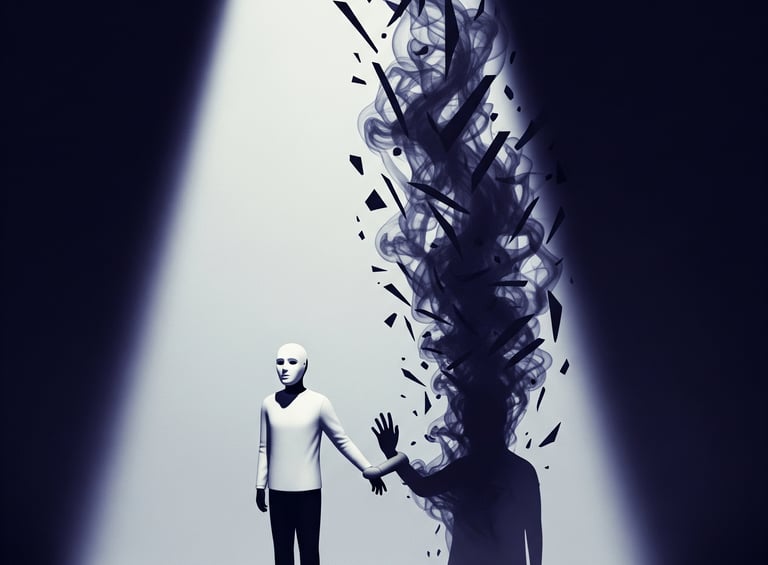
"I get it, I understand. There's people here who hold my hand. But what happens when... I can't comprehend someone holding my hand."
Stop and sit with that for a moment. He recognizes that help is available. He acknowledges that people are reaching out. But he cannot, and the word he uses is crucial, "comprehend" the help. It doesn't register. It cannot penetrate.
This is where Jungian psychology explains the mechanism of isolation with precision. When a person is possessed by a negative complex (or what Juice WRLD calls "demons"), they engage in psychological projection. They project their internal reality onto the external world. The projection isn't conscious or intentional. It's automatic and totalizing.
Because Juice WRLD feels internal hollowness, internal worthlessness, internal darkness, he cannot help but project that onto everything he perceives. When someone reaches out with genuine care, that caring gesture must pass through the filter of his Shadow-possession. The filter warps it, drains it of meaning, renders it incomprehensible. He literally cannot see what's being offered because his internal state has overwritten external reality.
This is why depression is so insidious. It's not just that you feel bad. It's that the depression rewires your perceptual apparatus so that evidence against the depression becomes invisible or gets reinterpreted as further evidence for it. Someone offers help? Must be pity. Someone says they care? Must be obligation. The negative complex protects itself by making contradictory evidence unprocessable.
From a Sartrean perspective, though, something else is happening here too: what Sartre called "bad faith" (mauvaise foi). Bad faith is the lie we tell ourselves to avoid the terrifying responsibility of freedom. It's the ways we pretend we have no choice when we do.
To "comprehend" the offered hand would require something almost unbearable: It would require stopping the cycle. It would require facing what Juice WRLD elsewhere in the song calls the long shot: of getting sober, of doing the hard work of integration, of choosing a different path. By claiming he cannot comprehend the help, there's a subtle way in which he's avoiding the responsibility of accepting it.
I don't say this to blame him. The pain is real. The psychological mechanisms are real. But Sartre would argue that even in the depths of suffering, we retain our freedom - and that freedom is precisely what makes the suffering so agonizing. We could choose differently, and we know it, and that knowledge is unbearable.
There's a dimension to this that both Jung and Sartre, for all their brilliance, tended to underemphasize: the sheer biological reality of the suffering body.
Throughout the song, there are references to physical symptoms: being unable to sleep, substance abuse taking its toll, the body in distress. This isn't metaphorical. When you're deep in depression and addiction, your neurotransmitters are dysregulated, your sleep architecture is destroyed, your nutrition is probably terrible, your nervous system is in chronic fight-or-flight mode.
You cannot think your way out of that state. No amount of insight, no depth of philosophical understanding, no brilliance of artistic expression changes the fact that your brain is operating with depleted serotonin, your body is flooded with cortisol, you haven't had REM sleep in weeks.
This is where the psychological models need to be grounded in biological reality. Before you can do Jungian integration work, before you can authentically choose in the Sartrean sense, you need to restore basic physiological functioning. You need to eat. You need to sleep. You need to move your body. You need to stabilize your nervous system.
One of the tragedies of Juice WRLD's story is that the substances he was using to try to manage his psychological pain were destroying the biological substrate necessary for psychological healing. He was trapped in a vicious cycle where the solution to the problem was making the problem unsolvable.
The song keeps circling back to substance use. Why? Because the alternative of actually facing the Shadow, actually dropping the Persona, actually accepting the hand feels impossible. It feels like it would require more strength than he possesses.
This is The Void at the center of the song: the sense that underneath everything, underneath the pain and the drugs and the demons and the success, there's just... nothing. No solid self. No ground to stand on. Just absence pretending to be presence.
Both Jung and Sartre, in different ways, recognized this Void. For Jung, it represented the dissolution that must precede reintegration - the necessary death of the old self before the emergence of the new. For Sartre, it was the nothingness at the heart of human consciousness - the fact that we are not things with fixed essences but pure freedom, pure possibility, pure choice.
But to someone in acute suffering, The Void doesn't feel like possibility. It feels like annihilation. And so the drugs, the Persona, the endless artistic expression... all of it becomes a way to avoid The Void, to fill it with something, anything, even if that something is pain.
If we're going to use these frameworks diagnostically, we should also consider them prescriptively. What would genuine healing have looked like for Juice WRLD? What does it look like for anyone caught in similar patterns?
The Jungian path would be Individuation, a lifelong process of becoming who you actually are by integrating the Shadow and dropping the Persona. Concretely, this would mean:
Shadow Work: Not trying to destroy the "demons" but dialoguing with them. What are they? Where do they come from? What do they want? What parts of yourself have you rejected that are now haunting you? The Shadow isn't the enemy. It's amputated parts of yourself demanding reintegration.
Persona Work: Consciously distinguishing between who you are and who you perform being. This might mean stepping back from the public eye, or it might mean finding ways to be more authentic within the public role. But it requires recognizing the mask as a mask... useful for navigating the world, but not who you are.
Active Imagination: Jung's technique for engaging with unconscious material consciously. Instead of being flooded by the demons, you sit down and have conversations with them. You let them speak. You listen. You negotiate.
The Sartrean path would be choosing Authenticity over Bad Faith:
Radical Responsibility: Accepting that you are free, even in suffering. You cannot control what happens to you, but you are always responsible for how you respond. This doesn't mean you can just choose not to be depressed. But it means recognizing that even in depression, you retain the capacity to choose your relationship to the depression.
Acknowledging The Look: Finding people who can see you, not just your Persona. This requires vulnerability and willingness to be seen without the mask. Terrifying, but necessary.
Choosing Existence: Sartre argued that existence precedes essence; we create ourselves through our choices. But this means we must actively choose to exist, to engage with the world, to act. Depression wants us to retreat into pure subjectivity, into the private hell of our own minds. Authenticity requires choosing relationship with reality, even when (especially when) that reality includes suffering.
The Biological path would require:
Medical Intervention: Proper psychiatric care, possibly medication to stabilize the neurotransmitter systems long enough for psychological work to occur.
Basic Self-Care: Sleep, nutrition, exercise, nervous system regulation. Not sexy or profound, but absolutely foundational.
Substance Recovery: Getting off the drugs that are preventing both biological and psychological healing.
The tragedy of "Feel Alone" is that it articulates the problem with devastating clarity while simultaneously revealing the psychological mechanisms that make the solution seem impossible to grasp. The offered hand cannot be comprehended. The long shot seems too long. The Void is too vast.
Here's what haunts me: Juice WRLD died of an accidental overdose at 21, less than a year after recording many of these songs. "Feel Alone" wasn't just artistic expression. It was documentation of an ongoing psychological emergency.
When you listen to it now, you hear someone describing exactly why they won't survive: the Shadow he can't integrate, the Persona he can't drop, the help he can't accept, the void he can't face, the drugs he can't stop using even though he knows they're killing him.
This is the peculiar horror of posthumous emo-rap: The artist is telling you exactly what's wrong, exactly what they need, exactly why they probably won't make it.... and we listen to it as entertainment, as mood music, as relatable content.
The song is a message in a bottle from someone drowning. And we streamed it millions of times while he drowned.
I don't want to romanticize Juice WRLD's suffering or suggest that his death somehow gave his art greater meaning. That's the worst kind of posthumous sentimentality. What I want is to take his testimony seriously and to recognize "Feel Alone" as a precise description of psychological mechanisms that many people experience but few articulate so clearly.
The Shadow doesn't respond to violence. You cannot drug it into submission, cannot pray it away, cannot perform your way past it. It demands integration... the hard, slow work of acknowledging that the darkness belongs to you and making room for it in your conscious identity.
The Persona cannot be your home. It's a tool, a necessary interface with the social world, but if you live in it, you suffocate. You must find ways to let the real self breathe, to be seen by someone, even if that visibility is terrifying.
The offered hand is real. The help is real. But when you're possessed by negative complexes, when you're projecting your internal void onto external reality, you literally cannot perceive it clearly. This is why healing almost always requires help from others; you need someone outside your perceptual bubble to keep insisting on a reality you can't yet see.
The Void is not the end. It's the necessary passage. Both Jung and Sartre understood that authentic selfhood requires passing through dissolution. But you have to survive the passage, and that requires support, resources, time.
And sometimes (more often than we like to admit) even with all of that, people don't make it. Not because they were weak, not because they weren't trying hard enough, but because the pain was real, the biological dysfunction was real, the psychological mechanisms were intractable, and the help, though offered, couldn't penetrate.
"Feel Alone" is a tragedy because it shows us someone who understood his own predicament with remarkable clarity and still couldn't escape it. That's not a failure of will or insight. That's the reality of severe psychological suffering.
What we can do and what we must do is listen when living people articulate similar struggles. Not as entertainment, not as relatable content, but as emergency signals. Behind the Persona, beneath the performance, there's often a person genuinely drowning, wondering if anybody notices.
We should notice. And we should reach out the hand, even when (especially when) they tell us they cannot comprehend someone holding it. Keep offering it anyway. Eventually, if we're lucky, the perception might shift enough for them to take it.
That's not guaranteed. Nothing is guaranteed. But it's what authentic care requires: persistent presence in the face of apparent futility, refusing to abandon someone even when they've already abandoned themselves.
That's the lesson in Juice WRLD's testimony. Not that art redeems suffering, not that genius excuses self-destruction, but that psychological pain this severe demands a clinical, philosophical, and human response. And that response must come while people are still alive to receive it.
The hand extended to the dead is just grief. The hand extended to the living is rescue. May we learn the difference.