Essays and Conversations on Community & Belonging

The Agony and Ecstasy of Limerence
I’ve been grappling lately with a specific form of human suffering that goes largely unnamed in our culture. It isn’t quite love, not quite addiction, and not quite obsession—though it shares the DNA of all three. Psychologists call it limerence: an involuntary, intrusive state where your entire inner life is hijacked by a desperate hope for reciprocation from another person. In this essay, I explore the "architecture of fantasy" behind this condition—from the childhood wounds that prime us for it, to the digital world that accelerates it. This is a look at why we trade reality for the "glimmer," and how we can transmute this painful longing into something that doesn't just consume us, but actually wakes us up.
PSYCHOLOGY & PERSONAL GROWTHTHE ARCHITECTURE OF THE SELFTHE ANXIOUS MINDADDICTION & DOPAMINEPERFORMANCE V AUTHENTICITYDYNAMICS OF DESIRE
Alex Pilkington
11/29/202512 min read
A Personal Introduction
I've been thinking a lot lately about a particular form of human suffering that goes largely unnamed in our culture. It's not quite love, not quite obsession, not quite addiction, though it shares qualities with all three. It's invaded my life more than once, and as I grapple with it yet again, I found myself eager for an explanation and a roadmap to transform this feeling into something healthy.
The psychologist Dorothy Tennov gave this state a name in 1979: limerence. And while the term hasn't exactly entered common parlance, the experience it describes is nearly universal among those unfortunate enough to be wired for it. It's that overwhelming, intrusive preoccupation with another person that consumes your consciousness, hijacks your emotional stability, and makes you behave in ways that, in retrospect, seem almost deranged.
What distinguishes limerence from ordinary romantic attraction is its involuntary, obsessive quality. This isn't about having a crush or being smitten. This is about having your entire inner life reorganized around another person to the point where your mood, your self-worth, and your sense of reality itself becomes tethered to their perceived feelings toward you.
I want to explore this phenomenon not just because it's psychologically fascinating, but because I think it reveals something crucial about the human condition in late modernity. In an age of increasing atomization, digital mediation, and what we might call emotional homelessness, limerence offers a kind of terrible solution to the problem of meaning. It provides intensity, purpose, narrative which our flattened, administered world increasingly fails to supply.
The Architecture of Fantasy
Let me start with what actually happens in the limerent mind, because the mechanics are quite specific. Tennov's research identified a clear pattern: It begins with what might be called a "glimmer" (some brief interaction that feels unusually significant). Maybe someone really sees you for a moment. Maybe there's an unexpected kindness or a conversation that resonates. From this minimal material, the mind begins an extraordinary process of elaboration.
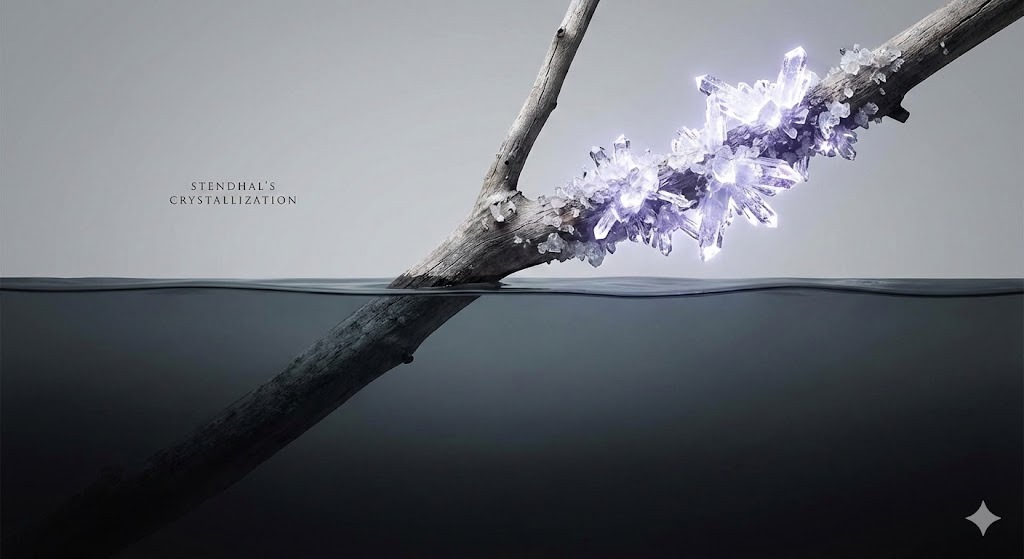
The French novelist Stendhal described this as "crystallization," using the metaphor of a branch left in salt mines that becomes encrusted with crystals until it appears transformed into something magical. That's what happens to the limerent object in your mind. You take an ordinary person (flawed, finite, struggling with their own demons) and you coat them in the jewels of your projection until they become an archetype: the Savior, the Muse, the One Who Will Finally Make You Whole.
Here's what's crucial: This isn't a conscious choice. The thoughts are intrusive. They invade your consciousness unbidden, like an infection. You'll be in the middle of work, and suddenly you're replaying a conversation from three days ago, analyzing every syllable for hidden meaning. The mind becomes what one researcher called an "interpretation machine," performing exhausted gymnastics to extract significance from neutral behaviors.
Did they smile at you? Surely it means something. Did they not say hello this morning? They must be upset, or playing hard to get, or testing your devotion. The rational part of your brain knows this is absurd. But that knowledge doesn't help, because limerence operates at a level deeper than rationality.
And here's the really insidious part: Your mood becomes entirely dependent on your interpretation of their signals. Tennov called this "affective dependency," which is clinical language for having your emotional thermostat controlled by someone else's perceived feelings. A kind word induces euphoria (Tennov called this "buoyancy"). Ambiguity or perceived rejection triggers despair. You're on an emotional rollercoaster where you're not holding the controls.
One of Tennov's subjects described making two lists: one of everything unpleasant about the person they were limerent for (a very long list), and one of their good qualities (a short list). It made no difference. The good qualities seemed overwhelmingly more important, and the bad things? Well, those were either overlooked or somehow reframed as endearing quirks. That's crystallization in action.
The Paradox of Uncertainty
Now, you might think that the solution would be simple: If this person clearly reciprocated your feelings, wouldn't the anxiety dissolve? Wouldn't mutual love resolve the obsession?
Here's where limerence reveals its truly perverse logic. Research on behavioral conditioning shows that unpredictable rewards create stronger behavioral patterns than consistent ones. B.F. Skinner's pigeon experiment demonstrated that a pidgeon that gets food sometimes but not always will keep pressing that button far more compulsively than one that always gets rewarded.
Human limerence works the same way. We don't become more attached in direct proportion to how much someone likes us back. We become most attached in conditions of uncertainty. We become attached when there's just enough hope to sustain the fantasy, but just enough doubt to keep us desperately seeking confirmation.
This is the "optimal zone" of limerence: enough positive signals to maintain possibility, enough ambiguity to prevent resolution. If the person were completely indifferent, the hope would eventually die. If they were obviously and consistently interested, the fantasy would collapse into the messy reality of an actual relationship. But in that middle zone of "maybe," the addiction flourishes.
And it is an addiction. The limerent brain is flooded with dopamine and cortisol, keeping you in a state of high-alert agitation that mimics aliveness. You're simultaneously desperate to spend more time with this person (to gather more data, to increase your chances) and desperate to avoid them (to protect yourself from potential rejection). Your will is divided against itself, which, as Marcus Aurelius knew, is a recipe for profound unease.
The physiological symptoms are real: racing heart, nausea, insomnia, inability to concentrate. Your body is in fight-or-flight mode. Yet paradoxically, many limerent people describe missing this state when it's absent. Life without limerence can feel dull, purposeless. The suffering, it turns out, is part of the appeal.
The Wound Beneath
So why do some people experience this and others don't? The answer seems to lie in a constellation of factors incorporating part genetics, part developmental trauma, part learned behavior.
There's often a genetic predisposition toward obsessive thinking, though not severe enough to constitute clinical OCD. There may be attention regulation difficulties similar to ADHD. And there's almost always an anxious attachment pattern formed in childhood.
When primary caregivers are inconsistent children learn that love is fundamentally unreliable. They learn that their value is conditional, that they must perform to earn affection, that who they really are is somehow unacceptable. This creates adults who are hypervigilant about abandonment and chronically uncertain about their worth.
But here's a particularly interesting pattern Tennov identified: Many limerent people have a history of what might be called the "swooper." In childhood, during periods of acute distress when parents failed them, a distant figure (an older sister, an aunt, a teacher, a family friend) showed up and provided perfect, temporary care. This person saw them, valued them, made them feel special. And then, crucially, left before disillusionment could set in.
The child's brain encodes a dangerous lesson: Perfect love exists. It comes from outside, from a distance. And if you can just find the right person, they will save you.
The adult limerent is unconsciously seeking this figure again in someone distant enough to remain idealized but close enough to offer hope of rescue. This explains why limerence often fades when the relationship is consummated. Proximity kills the fantasy. Real love requires knowing someone as they actually are, with all their ordinariness. Limerence requires distance to survive.
Fantasy as Anesthetic
We need to understand what limerence does for people. What need does it meet? What pain does it medicate? Because it's not random. It serves a function.
For many limerent people, especially those carrying too much responsibility in their lives, the fantasy offers psychological refuge. They imagine someone more capable, more together, looking down benevolently from above. If someone else knows better, if someone else is in charge, maybe they can finally relax. The fantasy doesn't require the other person's participation. The relief comes from the mental construction itself.
For others, limerence protects against genuine vulnerability. If someone really saw who we are (our flaws, our needs, our authentic mess) wouldn't they reject us? This is the terror at the heart of insecure attachment. Limerence solves this elegantly: We can experience intense longing while ensuring intimacy never actually occurs. We keep the person on a pedestal, perpetually striving to be worthy, never quite achieving it. We get to feel noble in our unrequited love while avoiding the much scarier prospect of being truly known.
The fantasy also occupies mental space that might otherwise be filled with more fundamental anxieties. Obsessing over someone's feelings became preferable to confronting career uncertainty and family dysfunction. The limerent preoccupation, however painful, felt more manageable.
This is why the "victim position" is so common: "I love so deeply but am not loved in return." It feels virtuous. It avoids the harder truth that we're not actually trying to love the real person at all. We're using their image for emotional self-medication.
The Will to Suffering
Here's perhaps the most uncomfortable truth about limerence: Many people actively want it.
People who've experienced limerence can aptly describe the suffering - the anxiety, the obsession, the way it derailed their lives. But in the same breath, they'll mention how intensely alive they felt, how nothing since has quite matched that emotional vividness. When not limerent, life can feel unbearably flat.
We live in an age of what might be called existential homelessness. Traditional sources of meaning (religion, community, grand political narratives and their orders) have largely collapsed. We're atomized, lonely, mediated by screens. Much of life feels administered, managed, flattened. Limerence offers an antidote. It provides a mission, a high-stakes narrative, a rush of intensity that makes existence feel vivid and purposeful.
Nietzsche understood this: We would rather will self-destruction than not will at all. We need to be oriented toward something, striving for something, consumed by something. Limerence satisfies this need absolutely. It's meaning-making in the absence of meaning.
This suggests that limerence isn't just triggered externally but that it wells up from within, seeking an outlet. Tennov called this "readiness" toward limerence. The drive exists in certain people, waiting for a suitable object. We're not passive victims of an emotion. At some level, we're choosing it.
Think about that for a moment: We're using another person (oftentimes someone we barely know) as a prop for our own emotional regulation. We project our unlived potential, our hunger for significance, onto them. We fall in love not with who they are but with who we might become if they loved us. It's a narcissistic project disguised as romance.
This also explains why limerence often intensifies with obstacles. Rejection doesn't discourage us; it strengthens the attachment. The suffering feeds the intensity, and the intensity is what we actually want.
The Digital Accelerant
While limerence has existed throughout history, our current technological moment has created unprecedented conditions for its cultivation.
Dating apps present us with carefully curated images and minimal text - just enough information to project fantasies onto, not enough to shatter them with reality. We swipe through potential objects, constructing elaborate narratives about people we've never met. Social media allows us to stalk someone's digital presence, consuming information about them without actual interaction, maintaining fantasies fueled by constant new material.
All of this happens in the head, not in the body. We develop intense feelings for people we know almost nothing real about. And when we do meet, modern dating culture actively discourages authenticity. We're taught to play games, maintain mystery, carefully manage impressions. The entire system is designed to keep us in fantasy rather than in genuine, messy, analog connection.
The paradox of choice makes it worse. When we believe infinite partners are available (an illusion created by apps) why struggle through the complex reality of any particular person? We can always swipe to find someone who better matches our fantasy. So we maintain shallow interactions with many people, constructing brief limerent episodes with each, never committing to the sustained effort required to move beyond fantasy into actual intimacy.
This is what I mean by late-modern limerence: It's not just a psychological quirk but a symptom of how we live now. Digitally mediated, emotionally homeless, starved for intensity, addicted to the possibility of connection while terrified of its reality.
Living in Two Worlds
When you're in the grip of limerence, you experience something like a split consciousness. Here you are, going through your normal life: work, relationships, responsibilities. You've built what might be considered a functional existence. And then there's this other thing, this invasion of your inner world by thoughts of someone who occupies maybe 0.01% of your actual day but 90% of your mental space.
You exist simultaneously in two realities: the mundane world of your actual life and the fantasy world dominated by the limerent object. These worlds remain mostly separate, creating profound internal fragmentation. You're one person in public, another person in the private theater of your mind.
The toll is real. People report neglecting work, friendships, health. They describe personality changes undertaken to appeal to the object. Their self-worth becomes entirely mediated through one person's perceived gaze. One of Tennov's subjects wrote: "If I had not kept this diary, I would never have believed myself capable of such long-term idiocy."
Limerence episodes typically last one to seven years. That's a lot of life to live in divided consciousness.
How It Ends (It Rarely Ends Well)
Resolution usually comes through one of several paths, none particularly satisfying.
Sometimes clear rejection breaks the spell. But often it just redirects the limerence to a new object. The most common pathway is increased proximity. When you actually get close to the person (when you start dating them, when you see them in the morning without makeup, when you experience their petty moods and boring habits) the idealization can't survive. They become ordinary. The fantasy dies. The projection ends.
This explains the perverse experience many limerent people have: They finally "win" their object, and the feelings immediately fade, often transferring to someone else entirely. The partner who seemed so magical becomes frustratingly normal, while some new person begins to glow with limerent significance.
Imagine being on the receiving end of that. Imagine being pursued intensely, finally reciprocating, only to have your partner's interest evaporate. It's bewildering and cruel, though usually unintentional.
The healthiest resolution seems to be extended distance and time. Without new interactions to fuel fantasy, the construction eventually collapses. But this requires recognizing what's happening and choosing to step away, which the limerent mind resists with everything it has.
Toward Transmutation
So what do we do with all this? The conventional responses seem inadequate. We can pathologize it and treat limerence as dysfunction requiring elimination. Or we can accept it as an unavoidable affliction, something to endure when it strikes. But both approaches miss something important.
What if we recognized limerence as revealing our capacity for intensity, passion, deep engagement? What if we learned to redirect that enormous energy toward chosen purposes rather than random objects?
The first step is radical honesty about the distinction between fantasy and reality. This requires what we might call forensic precision. When you catch yourself having strong feelings, trace them back to actual events that occurred. What specifically happened? What would a camera have recorded? Not your interpretation, just the bare facts.
"My friend was really there for me" is interpretation. "My friend sat with me for three hours while I talked" is fact. Learn the difference. Appreciate the fact, not the story you tell yourself about what it means.
The second step is embodiment. Limerence is a "neck-up" phenomenon meaning it lives entirely in the head. The cure must be "neck-down." Ground yourself in your body, in physical sensation, in present reality. Meditation, yoga, any practice that shifts awareness from mental theater to somatic experience.
Notice where you feel things. Is it anxious pressure in your head? Or is it warmth and relaxation in your body? Does the feeling arise from actual interaction, or does it intensify in absence, fueled by fantasy? These questions, answered honestly, reveal what's actually happening.
Third, address the underlying wounds. Work with a therapist to understand the attachment injuries, the unmet needs, the childhood pattern of the "swooper." Until you understand what function the fantasy serves, you'll just replace one limerent object with another, cycling endlessly without ever experiencing genuine connection.
But we might go further. People describe limerent-like states toward creative work, spiritual practice, even life itself after a brush with death. Franz Kafka had an intensely limerent relationship with his writing, oscillating between conviction and despair, producing brilliant work through this pattern. Someone recovering from near-fatal illness often experiences a limerent intensity toward mere existence.
What if we learned to cultivate similar intensity toward chosen purposes? Relationship therapist Esther Perel describes techniques that essentially harness limerent dynamics: creating distance to rekindle desire, introducing uncertainty, seeing your partner in novel contexts. The Stoics practiced temporarily imagining loss to intensify appreciation.
These point toward a possibility: We might learn to direct limerent energy consciously rather than having it unconsciously direct us. Not by eliminating the capacity for intensity, but by choosing its object and its expression.
A Conclusion of Sorts
I don't want to oversell this. Limerence causes real suffering. It leads people toward relationships that hurt them. It consumes consciousness and distorts perception. I'm not romanticizing it.
But I also think our cultural tendency to pathologize intense emotion leaves us impoverished. We value measured, reasonable affect. We treat passion with suspicion. And meanwhile, we're starved for meaning, for purpose, for the feeling of being fully alive.
Limerence, for all its dysfunction, offers that feeling. It provides intensity in a world increasingly characterized by flatness. It creates narrative in the absence of narrative. It generates meaning, however illusory, in an age when meaning feels scarce.
The question isn't how to eliminate this capacity but how to understand it, work with it, perhaps even harness it. This requires uncommon self-knowledge and discipline. It requires recognizing limerence as part of one's psychological architecture rather than as shameful aberration. It requires distinguishing fantasy from reality while honoring the human need for both.
Most of all, it requires compassion. Compassion for ourselves and compassion for others caught in this peculiar form of suffering. People in limerence aren't weak or broken. They're experiencing something deeply human: the longing for connection, the hunger for intensity, the desperate hope that another person might finally make us whole.
That hope is, of course, an illusion. Wholeness, if it exists, must be found within. But the longing itself tells us something important about what we're missing, what we're hungry for, what we need but cannot find in the administered world we've built for ourselves.
And perhaps that's the real lesson of limerence: It's a symptom of deeper hungers, a distorted expression of legitimate needs, a painful reminder that we remain, despite everything, animals who need meaning, purpose, and the electric feeling of being intensely, undeniably alive.