Essays and Conversations on Community & Belonging

Performing for the Panopticon: Honey Davenport, IML, and the Collapse of Families
A structural analysis of the foundational crisis facing modern queer subcultures. By examining the shifting dynamics of performance, this piece diagnoses how atomized individualism and digital shaming are replacing intimate self-discovery with corporate public relations.
SUBCULTURE & COMMUNITYTHE ALGORITHMIC CAGEPERFORMANCE V AUTHENTICITYTHE ARCHITECTURE OF FRAGMENTATION
Alex Pilkington
5/25/20264 min read

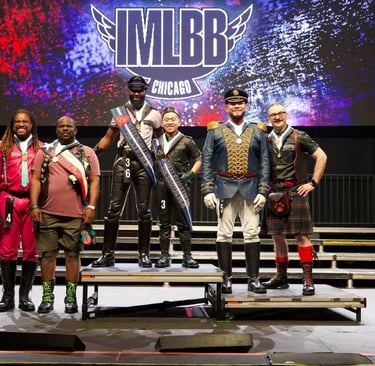
1. The Affective Split vs. The Foundational Crisis
The current discourse surrounding Honey Davenport’s IML victory often falls into a reductive trap: equating the drag and leather subcultures simply because they both rely heavily on elaborate costuming. While it is true that both embody highly specific aesthetics to signal identity, claiming they are the same ignores a fundamental difference in affect. The emotional expression, the energy, and the traditional archetypes these subcultures inhabit are distinctly different. Drag leans into hyperbole, parody, and the subversion of gender; leather leans into discipline, somatic eroticism, and the curation of intensity.
However, beneath these differing affective expressions lies a much more significant, and troubling, structural parallel. Both subcultures are currently experiencing the exact same foundational crisis: the erosion of the chosen family.
2. From Kinship to Individualism
Historically, the lifeblood of both drag and leather was the found family. Because traditional family structures were often denied to queer people, these subcultures built their own alternative institutions—Drag Houses and Leather Families. These were physical, insular networks of mentorship, housing, safety, and deep interpersonal bonds. Within these spaces, putting on leather or drag was a deeply personal, internal act of self-discovery. You explored your boundaries within the protective, physical presence of a trusted community.
Today, that infrastructure of kinship is being replaced by atomized individualism. As the physical family unit breaks down, the very purpose of performance changes. Without the grounding of an internal peers-and-elders network, the performance shifts from an internal exploration to an external imposition dictated by digital audiences. Participants are increasingly performing to meet the rigid, commercialized expectations of a globalized online crowd, rather than discovering themselves alongside their peers.
3. The Panopticon of the Modern Gaze
This shift from intimate self-discovery to public performance explains the seemingly contradictory, hyper-reactive behavior of community institutions. The knowledge that a global audience is watching fundamentally alters how an organization operates.
Consider the modern institutional panic. When IML severs ties with Touché—a historic Chicago staple—in the exact same week it crowns a mainstream drag queen, it looks like an ideological paradox. But it isn't. It is the predictable behavior of an entity responding to what cognitive scientist Steven Pinker calls the "illusion of common knowledge."
On social media, algorithmic personalization means everyone lives in an individualized silo. Yet, features like "Trending" pages and view counts trick our brains into a powerful psychological illusion: that everyone who matters is looking at this exact same thing right now. When IML issues an emergency statement returning a sponsorship donation because of "the untenable sins of the past" at a bar, they are not managing an insular, physical community. They are managing public relations inside a simulated public square.
4. The Digital Pillory and Institutional Panic
Social media doesn’t incentivize information sharing; it incentivizes emotionally charged virtue or vice signaling.
When an institution like IML uncovers a norm violation within its ecosystem, it faces Pinker’s concept of the digitized "town square pillory." In the past, subcultural disputes, behavioral corrections, or the enforcement of a "code night" (such as Touché’s traditional, enforced dress codes) happened within physical walls. If you didn't follow the code, you were dealt with locally.
But online, the "Like" and "Repost" buttons function as virality engines. Users rush to publicly condemn an institution or an affiliate not out of a measured desire for justice, but as a ritual of group affirmation. They are signaling to their peers: "I see the violation, and I am publicly standing with the group." This quickly snowballs into a bullying mob driven by the fear that if you don't join the shaming, the mob might turn on you.
Faced with this explosive digital panopticon, IML’s leadership cannot afford nuance. They cannot quietly mediate or allow traditional, insular institutional norms to play out. They must engage in highly visible, immediate excommunication to satisfy the modern gaze. Ideological sorting and public performance take priority over objective, internal community cohesion.
5. The Market of Authenticity vs. The Architecture of Trust
It is easy to look at this commercialized, hyper-surveilled landscape and fall into cynicism, assuming that human subcultures are entirely driven by greed and power. But as economists remind us, markets do not actually thrive on our worst instincts; they thrive on our best—creativity, persuasion, and cooperation. Greed is not a modern invention, nor is it unique to digital spaces. Cavemen and medieval lords were greedy, yet they didn't build thriving, liberatory subcultures.
What builds a subculture is cooperation and trust, and that structural breakdown is precisely why Honey Davenport commands an innate sense of trust.
She represents an increasingly rare bridge to the foundational, pre-digital structures of these communities. Her legitimacy does not come from her aesthetics, nor does it come from how well she plays to the digital crowd. Her legitimacy comes from her lineage. She is rooted in a great drag family, and she is rooted in a great leather family. She was formed by the exact systems of mentorship and physical kinship that are currently fast disappearing.
Trusting her leadership isn't about agreeing with her on every political or aesthetic point; it is a recognition that she understands the architecture of the community because she was built by it—long before the digital audience stepped in to watch.