Essays and Conversations on Community & Belonging

An Inquiry into a Contradiction: The Illiberal Leather Communist
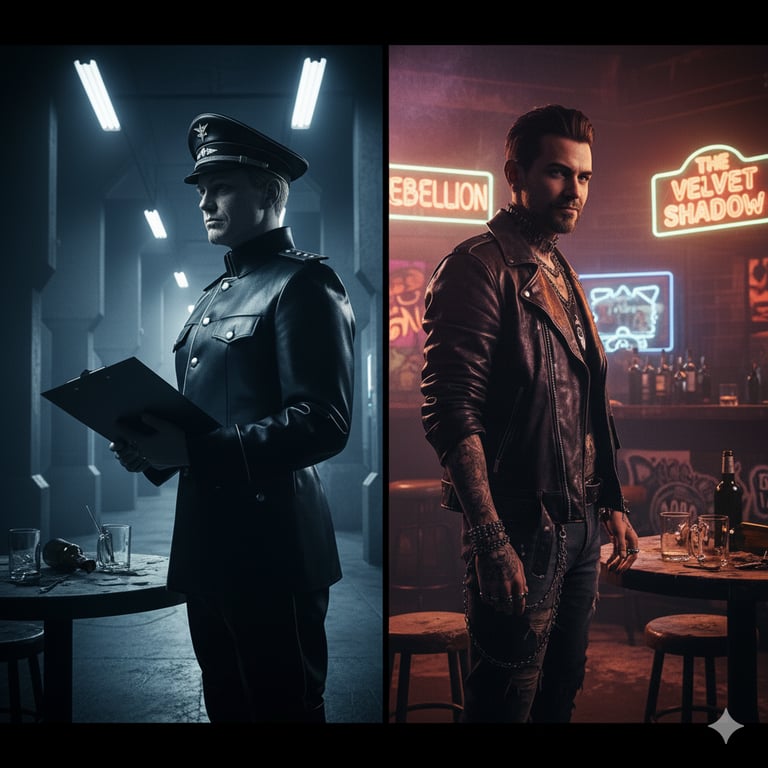
The rebel's harness or the commissar's leash? This piece accuses a new faction of leather communists of betraying the community's libertine soul by swapping radical individualism for ideological purity tests. It asks how a culture that fought the cops can now tolerate a new breed of thought police in its own ranks.
CULTURAL & ARTISTIC ANALYSISTHE FRACTURED REPUBLICILLIBERALISMSUBCULTURE & COMMUNITY
Alex Pilkington
10/17/20253 min read
The Libertine and the Commissar: A Question for the Modern Leather Communist
The leather community has always been a haven for the outcast and the radical. Its foundations were laid not by committee, but by the fierce assertion of individual sovereignty. Our ethics of consent and aesthetics of rebellion are the lived expression of a philosophy that places the self-authored life above all else. This is the libertine spirit of profound tolerance for personal deviation and an inherent skepticism of any authority that would police it.
Within this haven, radicals of all stripes have historically found a home. Anarchists, liberals, and yes, communists, have coexisted in our spaces for decades. They were united not by a shared political program, but by a shared enemy: the suffocating conformity and state-sanctioned moralism of the outside world. There was an implicit understanding, and a libertine compact, that this was a space where personal exploration trumped political purity.
It is this compact that a new, illiberal faction of leather communists now seems determined to shatter. By importing the tactics of ideological policing, you are not continuing a radical tradition; you are violating the very principle that made this tradition possible. This is not an eviction notice. It is an inquiry into a deep and troubling contradiction.
The Paradox of the Rebel Who Demands Conformity
The history of our community is one of defiance. Our pioneers fought cops in the streets and judges in the courts for the right to be different, to be "deviant," to be left alone. They understood that the true enemy was any system, state or social, that demanded everyone think, act, and desire in the same way.
We must then ask: how can you, who claim this legacy of rebellion, now practice the very methods of the moral police? How can you engage in public denunciations, demand ideological recantations, and seek to ostracize those who dissent from your political line, when those were the precise tools used against our community for generations?
The original radicals in this space, regardless of their economic theories, understood that the freedom of the dungeon was predicated on the freedom from dogma. You seem to believe that freedom in the dungeon can coexist with a demand for dogmatic adherence outside of it. How do you reconcile your methods with the legacy of the rebels you claim as ancestors?
The Paradox of Libertine Expression and Illiberal Politics
The libertine nature of our subculture is its most essential feature. It is the freedom to explore the furthest reaches of one's psyche and desires, free from the judgment of the collective. It is a radical commitment to the idea that there is no "correct" way to be, only your way, freely and consensually chosen.
Herein lies the second question: how does this radical embrace of personal pluralism square with a political practice that increasingly demands ideological monolithism? Your activism appears to subordinate the complex, messy, and often contradictory individual to a rigid political category. It seeks to replace the individual's conscience with the party line.
How can a culture built on the meticulous, granular, and personal negotiation of consent coexist with a political movement that engages in call-outs and cancellations - the very antithesis of consent culture's emphasis on direct communication and mutual respect? How can you champion the absolute freedom of the playroom while seeking to curtail the freedom of thought and association in the community lounge?
A Question of First Principles
This leads to the ultimate philosophical challenge. The historic leather communist could be a libertine first and a communist second; their presence in the community was an expression of their individualism, their economic theory a separate matter. The modern variant appears to be a commissar first.
A culture of consent is built upon the micro-level sanctity of an individual’s “no.” The political tactics you import are built on the macro-level invalidation of that “no” if it clashes with a perceived collective good. One cannot, it seems, truly serve both the sovereign individual and the demanding collective.
The question is not whether a communist can wear leather. The question is whether a person who seeks to enforce ideological conformity can still be a part of a libertine culture. In trying to purify the community, you risk destroying the very thing that made it a refuge in the first place: its unwavering commitment to radical, uncompromising individualism.