Essays and Conversations on Community & Belonging

Emotional Age and the Architecture of Connection
We live in a culture obsessed with external achievement, but we have almost no framework for assessing emotional maturity. The diagnostic question is simple but brutal: When someone you depend on lets you down, who do you become? Do you sulk, rage, or go cold? These aren't just character flaws; they are ancient survival strategies. But they are also the primary obstacles to building genuine safety in our relationships.
DYNAMICS OF DESIRETHE ANXIOUS MINDDIGITAL LIFE & THE ATTENTION ECONOMYSHADOW AND PERSONAPSYCHOLOGY & PERSONAL GROWTHTHE ARCHITECTURE OF THE SELF
Alex Pilkington
1/23/20264 min read
The Shadow in the Room
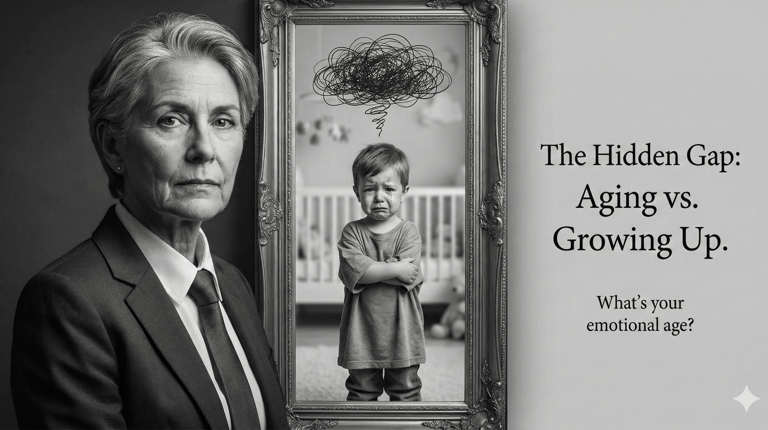
There is a peculiar paradox at the heart of our modern condition, one that I find myself returning to often. We can reach our 50s with graying hair and a CV full of professional accomplishments—managing complex systems, navigating legal frameworks, or organizing entire communities—while still responding to disappointment with the emotional architecture of a five-year-old.
We live in a culture that meticulously tracks physical development and celebrates intellectual achievement. Yet, we have almost no framework for assessing the thing that actually determines the quality of our inner lives and the viability of our communities: our emotional maturity.
This isn't just about "being nice" or maintaining professional composure. From a Jungian perspective, this is about the Shadow. It is about whether we have integrated the wounded child within us, or whether we are letting that child unknowingly drive the bus.
The diagnostic question is deceptively simple, yet it cuts through all our sophisticated defenses: When someone you depend on emotionally lets you down, who do you become?
The Three Faces of the Shadow
For many of us—especially those who grew up in environments where we had to hide parts of ourselves to survive—our default responses to pain are not choices. They are ancient survival strategies. They are the armor we forged when we were too young to have any other options.
The Sulk (The Silent Scream)
The first immature response is sulking. It is the logic of infancy: I shouldn't have to tell you what I need; you should just know.
This is a desire for psychological merger, a fantasy that true connection means telepathy. When we sulk, we radiate hurt while denying it exists. We create a "double bind" for the other person—demanding they fix a problem we refuse to name. In an analog relationship, where presence is everything, sulking is a way of being physically present but emotionally absent. It is a refusal to engage in the messy, necessary work of articulation.
The Rage (The Amygdala Hijack)
The second response is disproportionate anger. This is the rage exploded outward. When we feel small, abandoned, or unheard, we puff up. We get loud. We mobilize for war.
This rage often looks like strength, but it is actually terror. It is an attempt to force the world to acknowledge us. For those of us who have experienced marginalization or neglect, this response makes sense—if you had to scream to be heard as a child, you will scream when you are hurt as an adult. But in a community context, this rage destroys the very safety we are trying to secure.
The Coldness ( The Fortress)
The third response is perhaps the most devastating to community building: indifference. We shut down. We tell ourselves, "I don't care," "I don't need this," "I'm better off alone."
This is the dismissive-avoidant style, the "fortress of indifference." It is emotional amputation. If rage is a fight for connection, coldness is a preemptive strike against it. We numb ourselves to avoid the shame of vulnerability. In a world of digital alienation, this is the easiest path to take—we can just stop replying, stop showing up. But it is a death sentence for genuine connection.
The Analog Work of Growing Up
If these are the defenses of the child, what does the adult do?
Emotional maturity is not about achieving some Zen-like state of detachment. It is about integration. It is about recognizing that we can be hurt without being destroyed. It requires three specific capacities that are essential for any strong, analog relationship:
The Capacity to Explain: We must move the experience from the murky waters of the unconscious into the clarity of language. We have to say, "I feel hurt because..." This is an act of trust. It assumes the other person is not an enemy, but a partner in the negotiation of reality.
The Capacity to Regulate: We need to hold the tension of the opposites. We can be angry and still love the person. We can be disappointed and not burn the house down. This is the difference between acting out a feeling and feeling a feeling.
The Capacity for Vulnerability: This is the core. In the leather community, we understand that there is immense power in surrender, in revealing one's neck. Emotional maturity operates on the same principle. Admitting "I need you" or "I am lonely" is not a weakness; it is the only foundation upon which real strength can be built.
Building Better Communities
We cannot build strong communities if we are operating from our childhood wounds. We cannot organize, we cannot support one another, and we cannot fight the modern plague of alienation if we retreat into sulking, rage, or coldness every time we face friction.
The work of growing up is slow, analog work. It happens face-to-face. It happens in the uncomfortable silence before we choose to speak our truth instead of shutting down. It happens when we choose to strip off the armor—whether that armor is a suit, a leather jacket, or a wall of cynicism—and let ourselves be seen.
We are not condemned to repeat our patterns forever. We can learn a new language. And in doing so, we might finally find the connection we have been searching for all along.